
Blog
Georgia’s New Inclusive Playground Requirements: What Schools Need to Know About HB 371
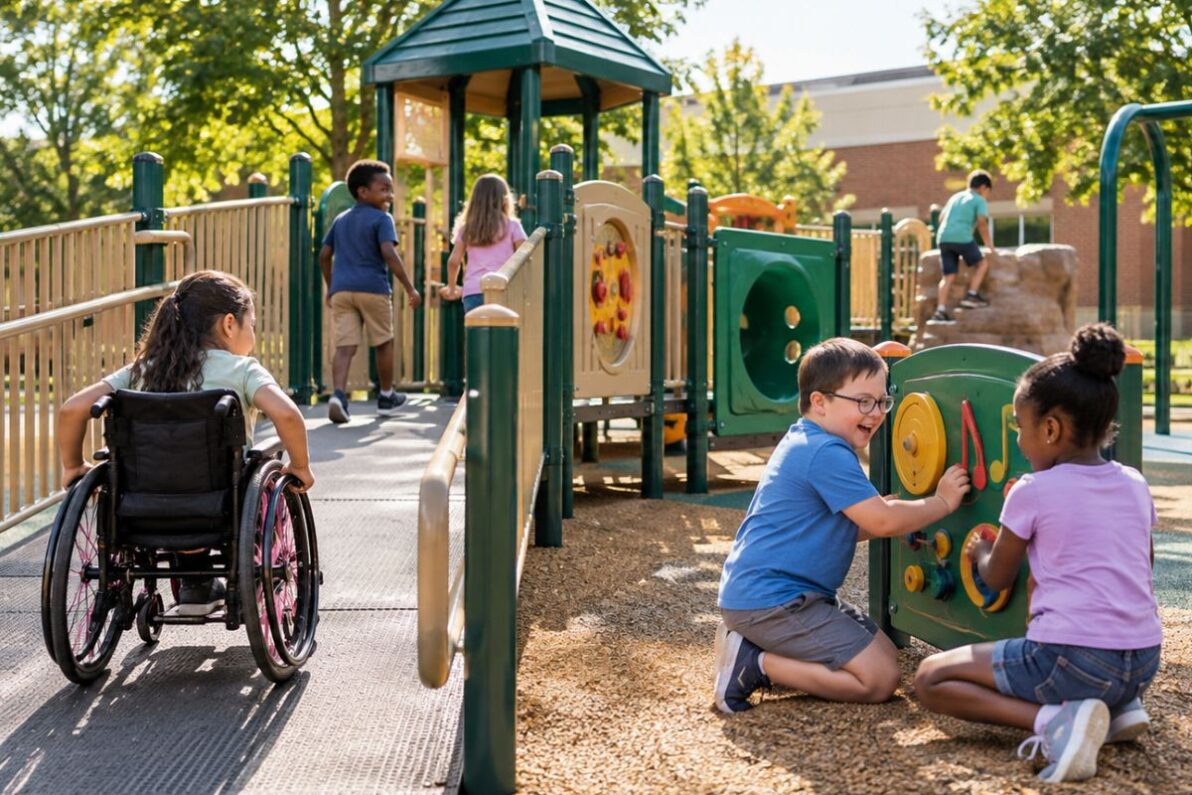
Georgia is taking an important step toward making play more accessible and meaningful for children of all abilities.
On May 9, 2025, Governor Brian Kemp signed House Bill 371 into law. Among its provisions, HB 371 establishes inclusive design requirements for playgrounds included with new public elementary schools constructed on or after July 1, 2027.
For Georgia school districts, architects, contractors, and other project stakeholders, the new requirements make inclusive playground planning an important part of the school design and budgeting process.
Which Playgrounds Are Covered by HB 371?
The new standards apply when:
- A new public elementary school is constructed on or after July 1, 2027
- The new school includes a playground
The requirements also apply to public charter elementary schools. However, the law does not state that every existing school playground must be replaced or renovated by that date. It also does not establish the same mandate for private-school playgrounds.
Although the playground construction requirement begins in 2027, planning should begin much earlier. School construction projects require coordination among school systems, architects, contractors, equipment providers, and other specialists. Inclusive design, surfacing, shade, fencing, site access, and equipment selection should be considered while the project is still being designed and budgeted.
What Does HB 371 Require?
Under the new law, qualifying elementary school playgrounds must provide a sensory-diverse environment where children of different abilities can develop physically, socially, and emotionally.
The playground must offer age-appropriate and ability-appropriate challenges, opportunities for children of all abilities to succeed, and access to the benefits of Georgia’s required elementary school recess time. The space must also be capable of serving as an outdoor classroom that is open to all students.
In addition to these broader goals, the law establishes several measurable requirements.
An Accessible Route from the School
The playground must be accessible from the school by a sidewalk or pathway. Accessibility needs to begin before a child reaches the play area, making the route to the playground an important part of the overall design.
At Least 10,000 Square Feet
A qualifying playground must contain a minimum of 10,000 square feet. This requirement should be considered during site planning so there is enough room for equipment, circulation, inclusive play areas, shade, fencing, and outdoor learning.
Fencing Around the Entire Playground
Fencing must surround and enclose the complete playground area. Fence placement, gates, accessible entrances, traffic flow, and supervision should all be incorporated into the early design process.
Shade Over at Least 20% of the Playground
At least 20% of the total playground area must be shaded. The shaded space may be divided among multiple areas and may come from natural or man-made sources, including mature trees and shade canopies.
Thoughtful shade placement can also help protect children and caregivers from Georgia’s sun while making the playground more comfortable during warmer months.
Unitary Surfacing Across at Least 80% of the Area
At least 80% of the playground must use unitary surfacing. HB 371 identifies turf, bonded rubber, and poured-in-place rubber as examples.
Unlike loose-fill materials, unitary surfacing creates a continuous surface that can make it easier for wheelchairs and other mobility devices to move throughout the playground. Surfacing decisions also affect drainage, maintenance, fall protection, accessibility, and the overall project budget.
Multiple Inclusive and Accessible Play Components
The unitary-surfaced portion of the playground must include multiple accessible components addressing a range of needs, including:
- Physical
- Sensory
- Cognitive
- Social
- Emotional
- Imaginative
- Communication
The law lists several examples of components that may contribute to an inclusive playground:
- Communication boards
- American Sign Language alphabet panels
- Braille alphabet panels
- Roller slides
- Musical equipment such as chimes, drums, and bells
- Adaptive or accessible swings
- Play pieces children can use while remaining in their wheelchairs
- Sensory panels
- Wheelchair-accessible raised structures
- Wheelchair-accessible slides
These examples demonstrate that inclusive play involves more than providing access to the edge of a playground. The goal is to create a space where children with different abilities can participate, explore, communicate, and play together.
Why Early Planning Will Be Essential
The law’s requirements are interconnected. The playground’s overall size affects equipment layouts. Surfacing affects accessible movement. Shade structures require proper placement and footings. Fencing affects entrances and circulation. Elevated accessible structures may influence both the budget and the space needed around equipment.
Addressing these elements separately or late in the project can create design conflicts, unexpected expenses, and delays.
Planning early gives project teams more time to:
- Evaluate the proposed site and accessible route
- Allocate the required playground footprint
- Compare unitary surfacing options
- Plan shade coverage
- Select inclusive equipment for different developmental needs
- Coordinate fencing, gates, drainage, and site preparation
- Develop a realistic budget and installation schedule
It is also important to remember that meeting a list of technical requirements does not automatically create a successful inclusive playground. The most effective designs consider how children will move through the space, which activities they can enjoy together, and whether the playground offers meaningful choices for different ages, abilities, and interests.
The Impact Goes Beyond New Elementary Schools
HB 371 specifically addresses playgrounds included with newly constructed public elementary schools. However, the principles behind the law can benefit many other outdoor spaces.
Existing schools, private schools, childcare centers, parks, churches, HOAs, and community organizations can voluntarily incorporate inclusive equipment, accessible surfacing, sensory play, communication features, and shade into new playgrounds or future upgrades.
Creating a more inclusive space does not always require replacing an entire playground at once. Depending on the site, an organization may be able to improve inclusion by adding accessible swings, ground-level play components, musical features, sensory panels, communication boards, shade, or more navigable surfacing.
Start Planning Your Inclusive Georgia Playground
Southeast Outdoors Solutions is based in Georgia and provides full-service support for commercial playground projects, from consultation and site evaluation through design, equipment selection, surfacing, shade, installation, and ongoing maintenance.
Our customizable approach allows us to select from multiple manufacturers and develop a playground that reflects your available space, project goals, budget, and the needs of the children who will use it.
If your school system or project team is planning a new elementary school, now is the time to begin discussing how the playground will address Georgia’s upcoming requirements.
Contact Southeast Outdoors Solutions to start planning a safe, engaging, and inclusive outdoor play environment.
This article provides a general summary of HB 371 and is not legal advice. Project-specific requirements should be confirmed with the school system, project architect, and appropriate state and local authorities.